Listening for NASA
Recording Mach 15 (5 km/s) impacts and transforming planetary data into sound.

Listening for NASA
Recording Mach 15 (5 km/s) impacts
Transforming planetary data into sound.
RESEARCH AT NASA AMES CENTER
Recording Hypervelocity Impacts
In 2009 China Blue and Dr. Seth Horowitz, a Brown University planetary scientist, recorded NASA’s Ames Vertical Gun both inside and outside the chamber using customized seismic, boundary (PZM), and ultrasonic microphones to capture the sonic footprint of a hypervelocity impact.
The seismic microphones were placed both on the surrounding platform and against the central target. Boundary microphones were positioned 180 degrees apart across the platform, while the ultrasonic microphone was placed at the top of the chamber to create a complete acoustic array capable of capturing the event from multiple perspectives.
The microphones were monitored live on separate channels and recorded using high-resolution digital software systems.

SEISMIC
MICROPHONES
Platform & target

BOUNDARY
(PZM)
MICROPHONES
180° array

ULTRASONIC
MICROPHONE
Top of chamber
The Chamber
A FACILITY BUILT FOR IMPACT
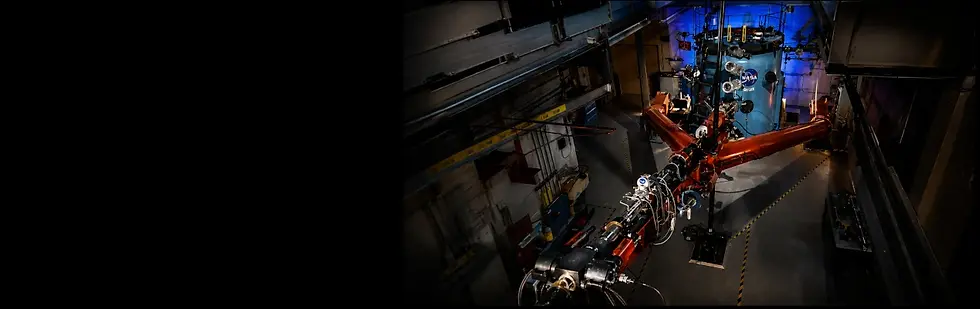
NASA’s Vertical Gun is one of the few facilities in the world capable of launching projectiles at speeds approaching 7 kilometers per second. These hypervelocity impacts simulate cosmic collisions, from micrometeoroids striking spacecraft to asteroid impacts on planetary surfaces.
Our recordings capture the acoustic signatures of these events through specialized microphones and sensors distributed throughout the chamber, turning vibration into audible evidence.

UP TO 15 KM/S OR
MACH 15
Launch Velocity

METEORID TO
MICROMETEORID
Impact Range

HIGH RESOLUTION
ACOUSTIC RECORDING
96kHz / 24bit
PLANETARY SONIFICATION
Listening to Saturn
SOUNDS IN SATURN’S RINGS
Since Galileo’s first observations in 1610, Saturn has remained one of the solar system’s great objects of wonder. The planet’s rings, once mysterious, are now understood to consist of countless particles moving in complex orbital relationships.
In 2007, after a ten-year journey through the solar system, NASA’s Cassini spacecraft entered orbit around Saturn and began returning unprecedented streams of scientific data and imagery.
In 2018, China Blue and Dr. Seth Horowitz received a NASA grant to explore Saturn’s rings through sound. By listening deeply to Cassini’s data, they identified sonic events hidden within the rings, including particle behavior surrounding embedded moons, moonlet-created propeller disturbances, and the mysterious spoke formations moving through Saturn’s magnetic field.


THE ALBUM
Cassini's Dreams
A MUSICAL INTERPRETATION OF A SPACE VOYAGE
Cassini’s Dreams immerses the listener into the deep and complex dramas unfolding within Saturn and its vast rings, while the spacecraft’s quiet yet extraordinary systems maintained their connection to Earth and transmitted decades of discovery.
A combination of algorithmic and inspirational approaches allows listeners to experience Cassini’s voyage translated through mathematics, sound, and music.